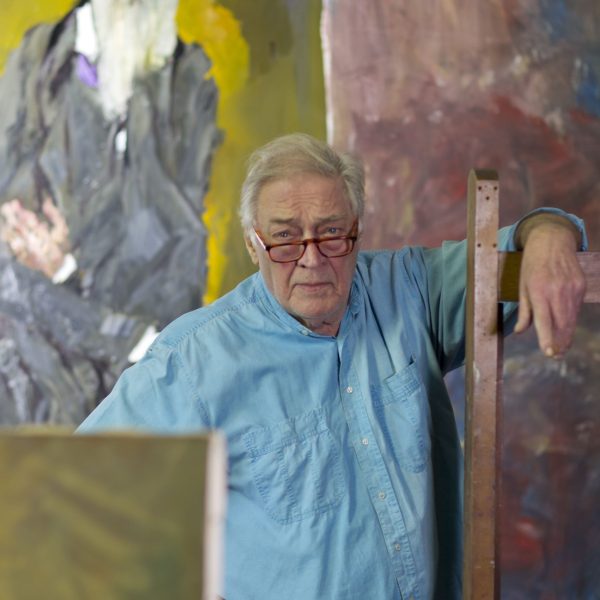
GIANCARLO VITALI
Artist
Born in Bellano, on Lake Como, on 29 November 1929, he began painting at the age of fifteen, after a period working at the Istituto d’Arti Grafiche in Bergamo.
In 1983, after accidentally seeing a reproduction of one of his paintings, Giovanni Testori visited him. This meeting marked the beginning of a relationship of mutual esteem and friendship. The following year, Testori devoted an article to him on the culture pages of Corriere della Sera and organised what may be considered Vitali’s
first solo exhibition, in Milan.
From then on, Vitali exhibited in numerous public and private venues and published many catalogues and collections of prints.
Despite his reserved way of life, Vitali was discovered in 1983 by Giovanni Testori, one of Italy’s greatest art critics and writers.
Testori enthusiastically dedicated an article to him in Corriere della Sera, helping to launch his rapid rise to recognition—Vitali was already over fifty—and organising his first major solo exhibition in Milan. From that moment, Vitali’s work quickly gained acclaim. He received invitations to exhibit and important commissions throughout
Italy and abroad, culminating in the major retrospective Time Out, held at the invitation of the City of Milan across four prestigious venues. The exhibition explored every aspect of his art: painting, printmaking and drawing. It was a major event celebrating one of the most talented contemporary artists. Vitali died on 25 July 2018.
On 29 April 2025, the Giancarlo Vitali Museum opened in Bellano. Housed in the ground-floor rooms of Palazzo Lorla, it presents the permanent collection of the painter and printmaker, featuring a significant selection from his extensive body of work: more than 100 paintings created over a period of seventy years.
The Museum pays tribute to an artist who engaged with the figurative traditions of the twentieth century, drawing from them distinctive elements that would nourish his own painting.
Deeply rooted in the Lombard tradition, Giancarlo Vitali’s art is in constant dialogue with art history and draws inspiration from the lake and the land where he was born. These elements, often used as points of reference and metaphor, were transformed into a pictorial language that reached beyond regional boundaries, also thanks to recognition from national and international critics.
The rooms that now house the Museum were once partly used as a workers’ club, with a function room, and as a bakery, later converted into a grocery shop.
The Museum project is the result of a collaboration between the Municipality of Bellano and the ArchiViVitali ETS Association, which gratefully accepted the donation made by the artist’s heirs.